Mobile proxy infrastructure has evolved significantly over the past few years, with 4gproxy solutions emerging as a critical tool for businesses requiring authentic residential IP addresses at scale. Unlike traditional datacenter proxies, a 4gproxy routes traffic through actual mobile network connections, leveraging cellular infrastructure to provide IP addresses that originate from consumer devices and carriers. This fundamental architectural difference makes 4gproxy technology particularly valuable for applications where detection avoidance and geographic authenticity matter most.
Understanding 4G Proxy Technology
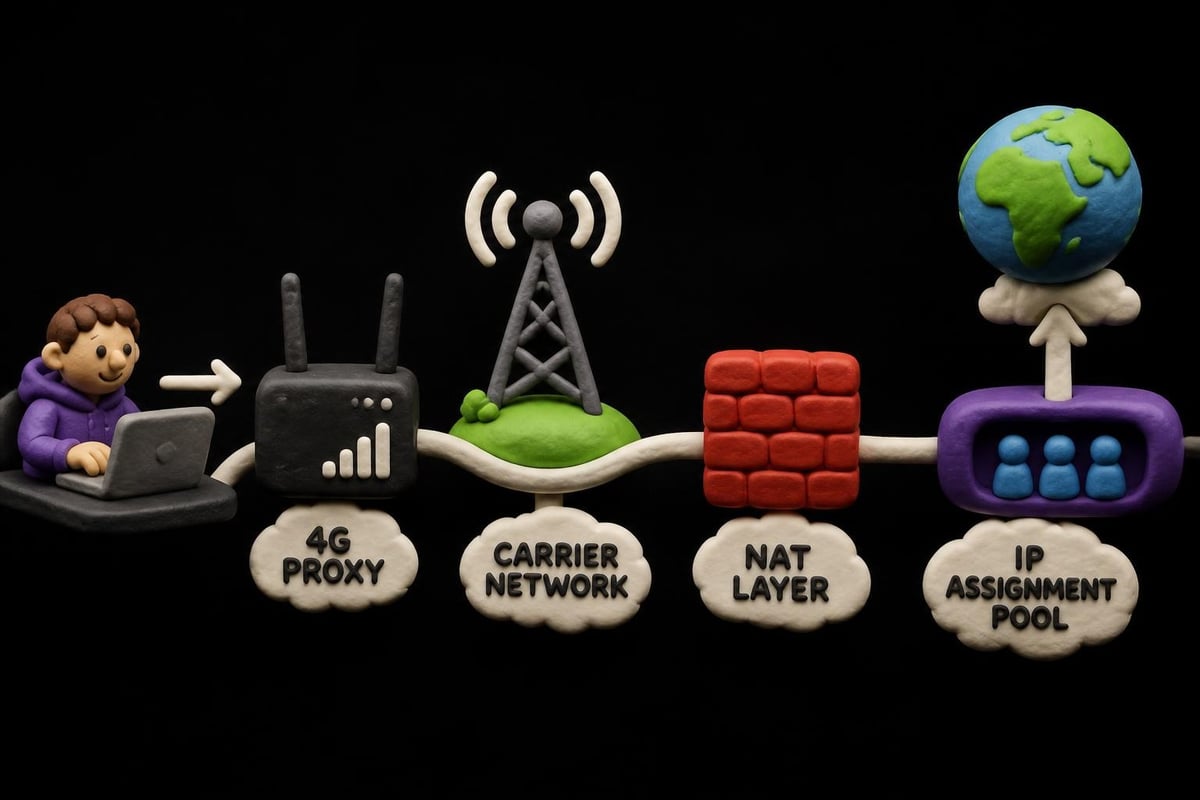
A 4gproxy operates by routing your internet traffic through devices connected to cellular networks, typically using LTE or 4G mobile data connections. These devices, equipped with active SIM cards from various mobile carriers, act as intermediaries between your requests and target servers.
The technical foundation involves mobile network operators assigning IP addresses dynamically from their consumer IP pools. When you connect through a 4gproxy, your traffic appears to originate from a regular mobile device browsing the internet through a carrier's network. This creates a significantly different fingerprint compared to datacenter infrastructure.
Core Components of 4G Proxy Infrastructure
Every 4gproxy system requires several interconnected elements:
- Physical cellular devices (smartphones, USB modems, or dedicated proxy hardware)
- Active SIM cards from mobile carriers across target regions
- Proxy software managing connection routing and session handling
- Power and connectivity infrastructure to maintain 24/7 operation
- IP rotation mechanisms leveraging carrier DHCP refresh cycles
The RFC 8683 deployment guidance for NAT64/464XLAT provides technical context for how mobile networks handle IP translation, which directly impacts how 4gproxy traffic traverses carrier infrastructure.
Advantages Over Datacenter and Residential Proxies
The value proposition of 4gproxy technology becomes clear when comparing it to alternative proxy types. Datacenter proxies, while fast and inexpensive, originate from hosting providers with easily identifiable ASN ranges. Many sophisticated platforms automatically flag or restrict traffic from known datacenter IP blocks.
Traditional residential proxies distribute traffic through homeowner internet connections, offering better authenticity than datacenters. However, they face availability constraints, bandwidth limitations, and ethical concerns about how residential IP pools are assembled.
A 4gproxy bridges these gaps effectively:
| Feature | Datacenter | Residential | 4G Mobile |
|---|---|---|---|
| IP Authenticity | Low | High | Very High |
| Detection Risk | High | Medium | Low |
| Speed | Very High | Medium | High |
| Geographic Coverage | Limited | Broad | Targeted |
| Cost per GB | Low | High | Medium-High |
| Rotation Flexibility | Manual | Limited | Dynamic |
Mobile carrier IP addresses receive preferential treatment from many platforms because they represent genuine consumer traffic. Social media networks, e-commerce sites, and streaming platforms rarely restrict cellular IPs aggressively, since doing so would impact millions of legitimate mobile users.
IP Rotation and Session Management
One distinct advantage of 4gproxy infrastructure is the ability to trigger IP changes through airplane mode cycling or modem reconnection. Modern carrier networks typically assign a new IP address each time a device reconnects to the network, enabling rapid rotation without maintaining large IP pools.
This rotation capability matters for high-volume scraping operations where maintaining session persistence across thousands of requests could trigger rate limits. With 4gproxy technology, you can programmatically refresh your IP address every few requests or maintain the same IP for extended sessions, depending on your use case.
Primary Use Cases for 4G Proxies
Organizations deploy 4gproxy solutions across diverse scenarios where mobile IP authenticity provides strategic advantages. Understanding these applications helps clarify whether investing in mobile proxy infrastructure makes sense for your specific requirements.
Web Scraping and Data Collection
E-commerce intelligence, price monitoring, and competitive analysis all benefit from 4gproxy access. When gathering product data from major retailers or marketplaces, traffic originating from mobile carrier networks faces fewer challenges than datacenter requests.
Research from Northeastern University on cellular network performance demonstrates that mobile connections exhibit different latency and throughput characteristics than fixed-line internet, which can actually help requests appear more authentic to target systems analyzing traffic patterns.
A 4gproxy deployment for scraping typically involves:
- Target identification: Determining which sites restrict datacenter traffic
- Geographic mapping: Selecting carrier regions matching target audience locations
- Request distribution: Spreading requests across multiple mobile IPs to avoid per-IP rate limits
- Session handling: Maintaining cookies and state across IP rotations when needed
- Error handling: Implementing retry logic for cellular network disconnections
Social Media Account Management
Digital marketing agencies managing multiple client accounts across platforms like Instagram, Facebook, or TikTok face strict policies against automation and multi-account access. These platforms employ sophisticated fingerprinting to detect when multiple accounts access their services from the same IP address or device.
Using a 4gproxy allows each account to connect through a distinct mobile carrier IP, dramatically reducing the risk of account association and subsequent bans. The mobile network origin adds legitimacy that datacenter IPs cannot provide.
Ad Verification and Fraud Detection
Marketing teams need to verify that their ad campaigns display correctly across different geographic regions and network types. A 4gproxy enables advertisers to check ad placement, creative rendering, and landing page performance from authentic mobile network perspectives.
This becomes particularly important when mobile-specific campaigns target users in particular countries or carrier networks. Testing through the actual mobile infrastructure ensures accuracy that desktop-based verification cannot achieve.

Security and Privacy Considerations
While 4gproxy technology offers significant advantages, it also introduces security considerations that users must understand. The ENISA Threat Landscape 2024 highlights emerging threats in mobile network infrastructure that directly impact proxy security.
Risks of Compromised Mobile Infrastructure
Mobile proxy providers must secure physical devices, SIM cards, and network connections against unauthorized access. The Google Cloud analysis of SIM swapping campaigns demonstrates how threat actors exploit mobile account vulnerabilities to intercept traffic or compromise authentication flows.
When evaluating 4gproxy services, consider:
- Physical security: How providers protect devices from physical tampering
- SIM card management: Procedures for preventing unauthorized SIM swaps or cloning
- Network monitoring: Detection systems for identifying compromised devices
- Access controls: Authentication mechanisms protecting proxy endpoints
- Logging policies: What traffic metadata providers retain and for how long
Privacy Implications of Mobile Proxying
Some 4gproxy services operate using device farms with dedicated SIM cards and modems, while others use consumer devices through "proxyware" applications. The research on Android residential proxy malware reveals concerning patterns where mobile proxy apps extract excessive permissions and expose user data.
Legitimate 4gproxy providers maintain transparent infrastructure, operate their own device fleets, and implement strict zero-log policies. Less scrupulous operators may collect sensitive information passing through their networks or inject tracking mechanisms into proxied traffic.
The longitudinal analysis of free proxy services demonstrates how many "free" proxy offerings compromise user privacy through content injection, credential harvesting, or selling traffic logs to third parties. These risks apply equally to mobile proxy services.
Technical Performance Characteristics
Understanding the performance profile of 4gproxy infrastructure helps set realistic expectations and optimize configurations for specific workloads. Mobile network connections exhibit fundamentally different characteristics than fixed broadband or datacenter links.
Latency and Throughput Considerations
A 4gproxy connection introduces several latency components:
- Device processing: Time for proxy software to handle requests (typically 5-15ms)
- Cellular network RTT: Round-trip time to carrier's network core (20-80ms depending on signal strength)
- Carrier routing: Path through mobile operator's infrastructure (10-50ms)
- NAT translation: Processing at carrier-grade NAT layers (5-20ms)
Total latency for a 4gproxy request typically ranges from 40ms to 150ms, compared to 5-30ms for datacenter proxies in the same geographic region. However, this added latency often proves acceptable given the authentication benefits mobile IPs provide.
Throughput varies significantly based on cellular network conditions. LTE connections theoretically support speeds up to 100+ Mbps, but real-world 4gproxy performance typically achieves:
- Download speeds: 10-50 Mbps per connection
- Upload speeds: 5-20 Mbps per connection
- Concurrent connections: Limited by device hardware and carrier policies
IP Stability and Connection Reliability
Mobile networks exhibit higher connection variability than fixed-line internet. Factors affecting 4gproxy stability include signal strength fluctuations, carrier network congestion, and device thermal management.
Research on multipath TCP proxy techniques for cellular networks explores methods to improve mobile connection reliability through intelligent path selection and failover mechanisms.
Best practices for managing 4gproxy reliability include:
- Implementing automatic reconnection logic with exponential backoff
- Monitoring signal strength and proactively rotating problematic connections
- Distributing requests across multiple devices to avoid single points of failure
- Maintaining backup proxy pools for critical operations

Selecting a 4G Proxy Provider
The 4gproxy market includes providers with vastly different infrastructure quality, pricing models, and service reliability. Making informed selection decisions requires evaluating several dimensions beyond simple cost per gigabyte.
Infrastructure Transparency and Quality
Premium 4gproxy services own and operate their device fleets, providing transparency about hardware locations, carrier partnerships, and network architecture. Ask potential providers:
- Do you own your mobile devices or rely on consumer proxyware?
- Which mobile carriers and countries do your IPs originate from?
- How many devices support each geographic region?
- What is your typical IP pool size and rotation frequency?
- How do you handle device maintenance and SIM card replacements?
Providers offering vague answers or refusing to discuss infrastructure details may operate lower-quality networks or rely on problematic sourcing methods.
Pricing Models and Cost Efficiency
4gproxy services typically price through one of several models:
| Pricing Model | Best For | Typical Range |
|---|---|---|
| Per GB | Variable usage, scraping | $15-$50 per GB |
| Per Port | Dedicated IPs, continuous use | $100-$300 per port/month |
| Rotating Pool | High-volume distributed requests | $200-$800 per month |
| Pay-as-you-go | Testing, sporadic usage | $0.02-$0.08 per MB |
Compare pricing against your expected monthly usage and factor in overage charges, which can dramatically increase costs for providers with restrictive plans. Services like PinguProxy offer unlimited access models that eliminate overage concerns for high-volume users.
Protocol Support and Technical Features
Modern applications require proxy infrastructure supporting current network protocols. Essential 4gproxy features include:
- IPv6 compatibility: Supporting both IPv4 and IPv6 addressing as mobile networks transition
- HTTP/HTTPS support: Handling encrypted traffic without SSL decryption
- SOCKS5 protocol: Enabling application-level proxying beyond web browsers
- Authentication methods: API keys, username/password, or IP whitelisting
- API access: Programmatic control over IP rotation and session management
The NAT64 deployment discussion in RFC 7269 explains why dual-stack IPv4/IPv6 support matters increasingly for mobile proxy infrastructure as carriers migrate to IPv6-first architectures.
Compliance and Ethical Usage
Operating 4gproxy infrastructure or using mobile proxy services involves navigating legal, ethical, and platform-specific policy considerations. Responsible usage protects both your operations and the broader ecosystem.
Terms of Service and Platform Policies
Most online platforms explicitly prohibit automated access, scraping, or circumventing geographic restrictions in their terms of service. Using a 4gproxy to access these platforms does not exempt you from their policies.
Before deploying mobile proxy infrastructure for any use case, review:
- Target platform terms of service and acceptable use policies
- Rate limiting guidelines and API access alternatives
- Geographic restriction justifications and licensing agreements
- Data collection regulations in relevant jurisdictions
Many legitimate use cases exist for 4gproxy technology (competitive research, ad verification, security testing of your own properties), but users bear responsibility for ensuring their specific application complies with applicable rules.
Carrier Network Responsibilities
Mobile carriers impose terms on SIM card usage, often restricting commercial proxy operations or excessive data consumption. Operating a 4gproxy service at scale requires business-grade cellular plans or carrier partnerships that explicitly permit proxy traffic.
The ENISA telecom security incidents report documents cases where unauthorized SIM card usage and network abuse led to account terminations and legal action. Legitimate providers maintain proper carrier relationships to avoid these issues.
Advanced Configuration and Optimization
Extracting maximum value from 4gproxy infrastructure requires thoughtful configuration, monitoring, and optimization strategies tailored to your specific use cases.
Geographic Distribution Strategy
Effective 4gproxy deployments match IP geographic origin to target audience locations. If you're scraping an e-commerce site that serves US customers, using US-based mobile IPs reduces detection risk and improves accuracy.
Consider factors beyond country-level targeting:
- State or province specificity: Major platforms may show different content based on sub-national regions
- Carrier diversity: Distributing requests across AT&T, Verizon, T-Mobile prevents per-carrier rate limiting
- Urban vs. rural IPs: City-based mobile IPs may trigger different platform behaviors than rural areas
Request Pattern Randomization
Even authentic mobile IPs can trigger detection systems if request patterns appear automated. Implement randomization across:
- Request timing (random delays between 1-10 seconds)
- User-agent strings (rotating through common mobile browsers)
- Request headers (varying accept-language, accept-encoding)
- Session duration (maintaining some IPs for minutes, others for hours)
Monitoring and Health Checks
Proactive monitoring identifies failing 4gproxy connections before they impact production operations. Essential metrics include:
| Metric | Threshold | Action |
|---|---|---|
| Response time | > 5 seconds | Investigate device connectivity |
| Error rate | > 15% | Rotate problematic IPs |
| IP blacklist status | Any hits | Remove and investigate |
| Bandwidth usage | > 90% of plan | Scale infrastructure |
| Device temperature | > 45°C | Throttle or shutdown |
Automated health checks should test proxy connectivity, verify IP geolocation, and confirm target site accessibility every 5-15 minutes.
Integration with Existing Infrastructure
Successfully incorporating 4gproxy capabilities into existing systems requires careful architectural planning and appropriate tooling. Most organizations already operate proxy infrastructure for various purposes, making integration strategy critical.
Proxy Rotation Architecture
Rather than replacing all existing proxies with mobile alternatives, implement tiered fallback logic:
- Attempt request through datacenter proxy (fastest, cheapest)
- If blocked or rate-limited, retry through residential proxy
- If still blocked, escalate to 4gproxy (highest success rate)
- Log which tier succeeded for future optimization
This approach minimizes 4gproxy usage costs while maintaining high success rates. Over time, machine learning models can predict which proxy type will succeed for specific targets, optimizing tier selection.
API Integration Patterns
Most 4gproxy services expose RESTful APIs for programmatic control. Common integration patterns include:
Essential API endpoints:
- GET /proxy/list - Retrieve available mobile IPs
- POST /proxy/rotate - Force IP rotation for session
- GET /proxy/location/{country} - Filter by geography
- POST /session/create - Establish persistent session
- DELETE /session/{id} - Terminate and rotate
Quality providers offer client libraries in Python, Node.js, and other popular languages, simplifying integration versus raw HTTP API calls. For users exploring proxy options, understanding differences between mobile and free web proxy alternatives helps clarify when 4gproxy investment makes sense.
Load Balancing Across Providers
Enterprise-grade implementations often distribute traffic across multiple 4gproxy providers to ensure redundancy and optimize for regional coverage. A multi-provider strategy prevents vendor lock-in and maintains operations even if one provider experiences outages.
Implement weighted load balancing based on:
- Provider reliability metrics (uptime, error rates)
- Geographic coverage for target regions
- Cost per successful request
- IP pool size and rotation capabilities
Mobile proxy technology offers unmatched authenticity and detection avoidance for businesses requiring genuine residential IP addresses at scale. Whether you're conducting competitive research, managing multi-account operations, or verifying ad delivery, understanding 4gproxy architecture, security implications, and optimization strategies ensures successful implementation. PinguProxy delivers enterprise-grade mobile proxy infrastructure alongside datacenter and residential options, all backed by complete IPv4/IPv6 support, 1ms rotation capabilities, and 24/7 expert support to help you achieve your business objectives securely and efficiently.