
Free SOCKS5 Proxy Server: Risks and Better Alternatives
The promise of a free socks5 proxy server sounds appealing: anonymous browsing, geo-restriction bypass, and IP masking without spending a dollar. However, the reality behind these "free" services often involves significant security compromises, privacy risks, and reliability issues that can expose your data or business operations to serious threats. Understanding what SOCKS5 proxies are, how free versions operate, and why they present challenges is essential before routing your internet traffic through any proxy infrastructure.
Understanding SOCKS5 Protocol and Proxy Functionality
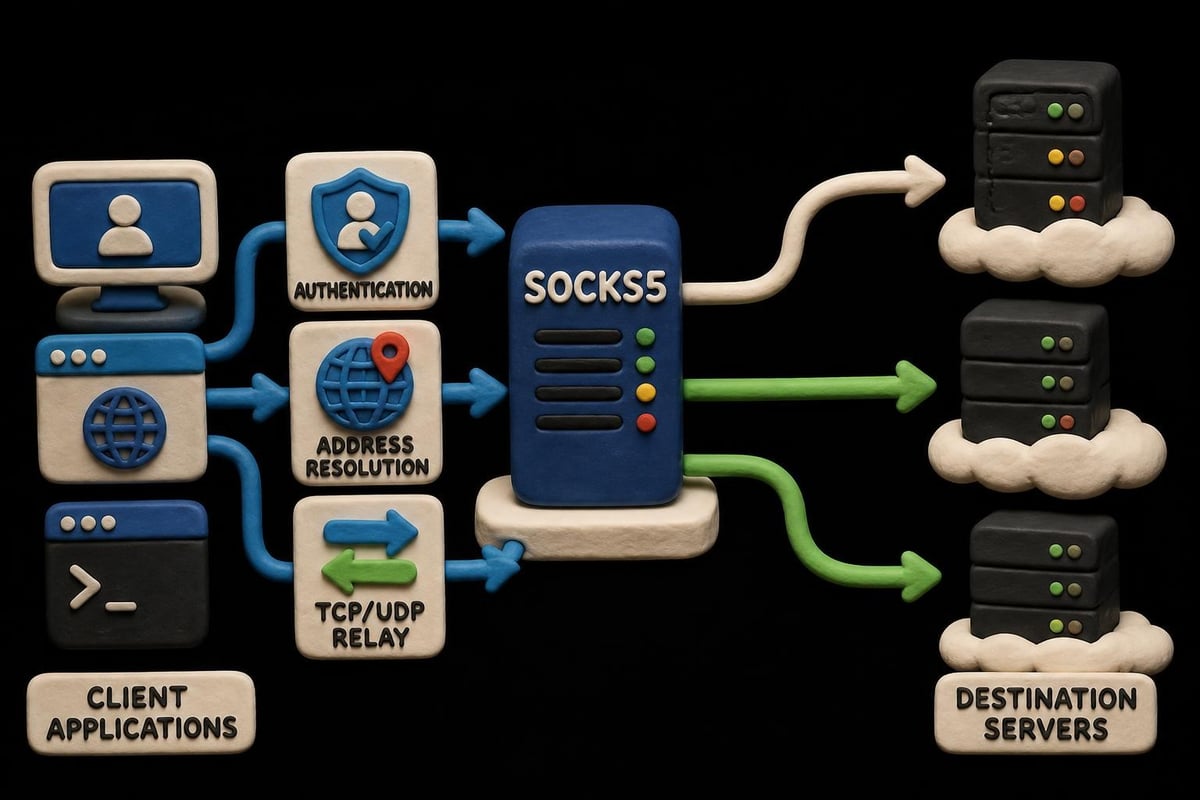
SOCKS5 represents the fifth iteration of the Socket Secure protocol, originally defined in RFC 1928 by the Internet Engineering Task Force. This protocol creates a versatile intermediary layer between your client application and the internet, handling TCP and UDP traffic with authentication support.
Unlike HTTP proxies that only work with web traffic, SOCKS5 operates at a lower network level. This fundamental difference allows it to handle virtually any type of internet traffic, from email and file transfers to gaming and peer-to-peer connections.
Key Technical Capabilities
- Protocol flexibility: Supports both IPv4 and IPv6 addressing
- Authentication methods: Username/password and GSS-API options
- UDP support: Critical for real-time applications like VoIP and gaming
- No content modification: Acts as a pure relay without altering packet data
The protocol's versatility makes SOCKS5 proxies particularly attractive for developers, security researchers, and businesses requiring granular network control. However, this same power creates significant vulnerabilities when proxy infrastructure lacks proper security measures.
The Free Proxy Business Model Problem
When you encounter a free socks5 proxy server, a fundamental question should immediately arise: how does the operator cover infrastructure costs? Bandwidth, server maintenance, IP address acquisition, and electricity all require substantial ongoing investment. Free proxy providers must monetize somehow.
Common monetization strategies include:
- Data harvesting and resale - Logging and selling your browsing patterns, credentials, or personal information
- Advertising injection - Inserting ads into unencrypted web pages you visit
- Bandwidth reselling - Using your connection as an exit node for paying customers
- Malware distribution - Injecting scripts or binaries into your traffic stream
- Credential theft - Capturing login credentials for financial gain
Research from MADWeb and NDSS symposiums has documented systematic security violations across free proxy services. Their longitudinal analysis revealed that 79% of free proxy servers engaged in malicious behavior, including SSL stripping, script injection, and credential harvesting.
Security Vulnerabilities in Free SOCKS5 Infrastructure
Operating a free socks5 proxy server creates numerous attack surfaces that malicious operators routinely exploit. Unlike reputable providers with clear privacy policies and security audits, free services typically lack accountability, transparency, or legal recourse when breaches occur.
Man-in-the-Middle Attack Risks
Free proxy operators sit directly between you and your destination, seeing every packet. Without end-to-end encryption, they can:
- Read unencrypted credentials and session tokens
- Modify responses to inject malicious content
- Redirect traffic to phishing sites
- Downgrade HTTPS connections to HTTP
Even when you're connecting to HTTPS sites, the proxy can still observe metadata: which sites you visit, when, and how much data you transfer. This information alone creates detailed behavior profiles valuable to advertisers or threat actors.
Data Logging and Privacy Violations
Premium proxy providers like those with zero-log policies implement technical and organizational measures to prevent data retention. Free services have no such incentive. Academic studies on free web proxies found that 68% explicitly logged user activities, while others couldn't be verified due to lack of transparency.
| Privacy Risk | Free SOCKS5 Proxies | Premium Services |
|---|---|---|
| Activity logging | 68-79% confirmed | 0% (verified zero-log) |
| Third-party data sharing | Common | Contractually prohibited |
| IP address retention | Indefinite | Typically < 24 hours or none |
| Legal transparency | None | Privacy policies + audits |
Performance and Reliability Challenges
Beyond security concerns, free socks5 proxy server infrastructure typically suffers from severe performance limitations that impact practical usability. These limitations aren't accidental-they're direct consequences of the free service model.
Bandwidth constraints represent the most immediate issue. Free proxies operate on minimal infrastructure budgets, often oversubscribing available bandwidth by 10:1 or higher ratios. When dozens or hundreds of users share a single connection, speeds plummet below usable thresholds.
Connection stability presents another critical problem. Free proxy lists typically include numerous servers that:
- Go offline without notice (average uptime often under 60%)
- Impose arbitrary connection limits or timeouts
- Block specific ports or protocols
- Experience routing issues due to poor infrastructure
For businesses relying on web scraping, continuous monitoring, or automated workflows, these reliability issues make free proxies practically unusable despite their zero cost.

Geographic Limitations and IP Quality Issues
The geographic distribution of free socks5 proxy server networks tends to be extremely limited and unpredictable. Unlike commercial providers maintaining infrastructure across dozens of countries, free services concentrate in specific regions where hosting costs are lowest.
This geographic clustering creates several problems:
- Limited options for geo-restriction bypass
- Concentrated IP ranges easily identified and blocked
- Poor routing to target destinations
- Timezone mismatches reducing effectiveness
Additionally, the IP addresses used by free proxies accumulate negative reputation over time. Security services like Cloudflare and other CDNs maintain databases of proxy IPs, particularly those associated with abuse. As documented in Cloudflare's developer guidance, sites routinely detect and block traffic from known proxy ranges, particularly free services with poor abuse prevention.
Malware and Injection Attacks
Perhaps the most dangerous aspect of using a free socks5 proxy server involves active content modification and malware injection. Security researchers have documented multiple attack patterns:
Script Injection Techniques
Free proxies frequently inject JavaScript into unencrypted HTTP responses. These scripts can:
- Mine cryptocurrency using your CPU resources
- Track your behavior across sites
- Redirect affiliate links to generate commission
- Create backdoors for persistent access
Binary Modification
More sophisticated attacks involve modifying downloaded executables or archives. The proxy intercepts software downloads and replaces or patches them with compromised versions. Users installing these applications unknowingly deploy malware or spyware on their systems.
SSL Stripping
Some free proxies actively downgrade HTTPS connections to HTTP, claiming "compatibility" or "performance" reasons. This attack exposes encrypted credentials and sensitive data to interception. The Electronic Frontier Foundation specifically warns against using untrusted proxies for this reason, recommending end-to-end encryption and verified secure channels.
Legitimate Alternatives to Free SOCKS5 Proxies
If you need proxy functionality but want to avoid the risks inherent in free services, several legitimate alternatives exist that balance cost, security, and performance appropriately.
Self-Hosted SSH Tunneling
Creating a local SOCKS5 proxy through SSH dynamic port forwarding offers a secure, free alternative when you control a remote server. Following Oracle's OpenSSH documentation, you can establish encrypted tunnels with a simple command:
The key advantages include full control over the endpoint, strong encryption by default, and no third-party access to your traffic. However, you need to maintain your own server infrastructure and handle configuration yourself.
Premium Proxy Services with Clear Value Propositions
Professional proxy providers operate on transparent business models with documented security practices. Rather than exploiting users, they charge subscription fees that fund:
- Genuine privacy protections: Verified zero-log policies with independent audits
- High-performance infrastructure: 10Gbps+ bandwidth with low latency
- Geographic diversity: Hundreds or thousands of locations worldwide
- IP rotation capabilities: 1ms rotation for enhanced anonymity
- Protocol support: Complete IPv4 and IPv6 compatibility
- Dedicated support: 24/7 technical assistance
These services align provider incentives with user needs. Your subscription pays for the infrastructure, eliminating the need for data harvesting or malicious behavior.

Use Case Considerations and Risk Assessment
Different use cases present varying levels of risk tolerance when considering a free socks5 proxy server. Evaluating your specific needs helps determine whether the cost savings justify the security tradeoffs.
| Use Case | Risk Level | Free Proxy Suitability | Recommended Approach |
|---|---|---|---|
| Web scraping | Medium-High | Poor (blocking/throttling) | Premium rotating proxies |
| Personal browsing | High | Dangerous (credential theft) | VPN or Tor |
| Gaming | Medium | Poor (latency/stability) | Premium datacenter proxies |
| Business operations | Critical | Never acceptable | Enterprise proxy services |
| Development/testing | Low-Medium | Limited acceptability | Self-hosted or premium tier |
For business applications involving sensitive data, customer information, or competitive intelligence, free proxies present unacceptable risks regardless of potential cost savings. The regulatory and reputational damage from a single breach far exceeds the subscription cost of legitimate services.
Network Security Best Practices
When implementing proxy infrastructure, whether free or paid, following modern security frameworks helps minimize risks. The Cybersecurity and Infrastructure Security Agency recommends Zero Trust architecture principles that apply equally to proxy deployments.
Essential security practices include:
- Always use end-to-end encryption (HTTPS/TLS) regardless of proxy trust level
- Implement certificate pinning for critical applications
- Monitor proxy traffic for suspicious patterns
- Maintain separate authentication credentials for proxy-routed traffic
- Regularly rotate proxy endpoints and IP addresses
- Deploy multi-factor authentication for proxy access
- Conduct periodic security audits of proxy infrastructure
Even when using trusted premium services, layering security controls ensures defense in depth. No single security measure provides complete protection-comprehensive strategies combine multiple overlapping safeguards.
Detection and Blocking Mechanisms
Understanding how websites detect proxy traffic helps explain why free socks5 proxy server options frequently fail for their intended purposes. Sites employ sophisticated detection methods that identify and block proxy users.
Common detection techniques include:
- IP reputation databases: Cross-referencing against known proxy IP ranges
- Behavioral analysis: Identifying non-human traffic patterns
- Header analysis: Detecting proxy-specific HTTP headers or anomalies
- Browser fingerprinting: Comparing claimed location with browser characteristics
- Connection timing: Analyzing latency patterns consistent with proxying
Free proxies, with their concentrated IP ranges and shared infrastructure, trigger these detection systems far more frequently than premium residential or mobile proxy networks. The resulting blocks and CAPTCHAs undermine the proxy's core value proposition.
Legal and Ethical Considerations
Using a free socks5 proxy server doesn't exist in a legal vacuum. Depending on your jurisdiction and use case, proxy usage may intersect with various legal frameworks governing privacy, computer fraud, intellectual property, and terms of service compliance.
Key legal considerations:
- Computer Fraud and Abuse Act (CFAA): Circumventing access controls may violate federal law
- Terms of Service: Many websites explicitly prohibit proxy access
- Copyright law: Using proxies to bypass geo-restrictions on copyrighted content
- Export controls: Routing traffic through certain countries may violate regulations
- Data protection regulations: GDPR and similar laws govern how proxy operators handle your data
Additionally, free proxy operators themselves may engage in illegal activities using your traffic as cover. When law enforcement investigates malicious activities, the trail may initially lead to your IP address if you're routing traffic through a compromised proxy.
The True Cost of "Free" Services
Evaluating a free socks5 proxy server requires accounting for hidden costs beyond the obvious security and privacy risks. These indirect costs often exceed the subscription fees for legitimate alternatives.
Hidden cost categories:
- Time investment: Constantly searching for working proxies, troubleshooting connection issues
- Performance impact: Reduced productivity from slow speeds and frequent disconnections
- Security remediation: Costs associated with credential resets, malware removal, or breach response
- Opportunity costs: Blocked access preventing completion of intended tasks
- Compliance risks: Potential regulatory penalties from data protection violations
For businesses, a single security incident resulting from free proxy usage can generate costs orders of magnitude higher than premium service subscriptions. Even for individual users, the cumulative time wasted and security risks rarely justify the minimal savings.
Making Informed Proxy Decisions
Selecting appropriate proxy infrastructure requires balancing multiple competing factors: cost, security, performance, reliability, and feature requirements. While a free socks5 proxy server might seem attractive initially, informed evaluation typically reveals serious limitations.
Premium proxy services justify their costs through measurable advantages:
- Guaranteed uptime: SLA-backed availability commitments
- Verified security: Independent audits confirming zero-log policies
- Performance consistency: Dedicated bandwidth avoiding oversubscription
- Global coverage: Extensive geographic distribution for geo-restriction bypass
- Technical support: Expert assistance resolving configuration issues
- Legal accountability: Clear terms of service and transparent business practices
These advantages translate into tangible business value: higher success rates for web scraping, reduced security incidents, improved productivity, and compliance with regulatory requirements.
While free SOCKS5 proxies might appear cost-effective, the security risks, performance limitations, and hidden costs make them unsuitable for serious applications. Whether you need proxies for web scraping, privacy protection, or accessing geo-restricted content, investing in verified infrastructure protects your data and ensures reliable performance. PinguProxy delivers enterprise-grade datacenter, residential, and mobile proxies with complete IPv4/IPv6 support, zero-log privacy protection, 1ms rotation capabilities, and 10Gbps bandwidth-backed by 24/7 support to ensure your operations run smoothly and securely.